
Being able to shoot away someone else's boule adds an important tactic to your game play. Obviously, it elevates you above the rank of amateur. Others will look upon you with respect, and you will find greater joy to even play the game better.
You might even decide to engage in those precision contests.
In France, shooters such as Dylan Rocher (26 yrs of age, 2017) and up-and-coming Tyson Molinas (18 years of age) are well known. Marco Foyot has been well-known for years and is regarded as the "King of Petanque". He was winning tournaments everywhere and showed different tricks with his boule. He brought petanque out of the shade of oak trees, so to speak.
I think Foyot can still do the stuff in his youth, but with age, and the rise of consistent point-and-shoot stars such as Quintais, Fazzino, etc., his "varied approach" to petanque is becoming kind of antiquated. Watch his head-to-head contest (video here) with Quintais from some years ago. You can see the difference in game play and skill, and perhaps the passing of a torch from Old Petanque to New. The passing of Foyot good friend, Passo, in 2015, perhaps marks the passing of the Renaissance Age of Petanque in the 80s in France.
In today's world of petanque, to succeed, you surely need to shoot well.
If you don't, then you have to think what to do next with your remaining boules.
It is disheartening to play with folks who can shoot well. It delegates your excellent pointing skills to the insignificant bin. BUT KNOW THIS: EXCELLENT POINTING ALWAYS PUT PRESSURE ON YOUR OPPONENT. SO, LEARN TO POINT WELL ALWAYS. LET YOUR OPPONENT HAVE THE CHANCE TO FAIL AT SHOOTING.
Shoot and point, shoot and point. Between good players, it becomes a contest of wills. One Madagascar Vs Thailand match was like that. And there were carreaus galore! Imagine that! Point exchanged for point. Watch the video here.
A. THE BASICS
- As a beginner you will probably find the boule too heavy to shoot with. Simply lifting your arm the way you point to shoot does not work. The boule does not and will not have forward momentum. A simple way to get around this is to work the elbow.
The Elbow Shot. Cup the boule in your hand in the normal fashion. Bring it up to your face so it just hides the target boule from view. That's your aiming point. Now, extend your elbow and drop swing the boule back roughly to just after your buttocks. This is your swing back.
In one motion, bring it back to the same level and release the ball.
Practice this a few times. You will realise this Elbow Shot method gets you a carreau every time. Why?
Because what you have done is drop shot the boule onto the target one.
Drop shot is the traditional gentle pendulum swing of the arm and boule. It will attack the target boule at 45 degrees with just enough forward force to take its place and NO BACKSPIN.
A good example of the drop shot is here. Regis Simba from Benin does it as well. Watch him in action here. In fact, most of the Madagascar players use this method too!
- As a beginner you will probably find the boule too heavy to shoot with. Simply lifting your arm the way you point to shoot does not work. The boule does not and will not have forward momentum. A simple way to get around this is to work the elbow.
The Elbow Shot. Cup the boule in your hand in the normal fashion. Bring it up to your face so it just hides the target boule from view. That's your aiming point. Now, extend your elbow and drop swing the boule back roughly to just after your buttocks. This is your swing back.
In one motion, bring it back to the same level and release the ball.
 |
| The Elbow Shot method of shooting. |
Practice this a few times. You will realise this Elbow Shot method gets you a carreau every time. Why?
Because what you have done is drop shot the boule onto the target one.
Drop shot is the traditional gentle pendulum swing of the arm and boule. It will attack the target boule at 45 degrees with just enough forward force to take its place and NO BACKSPIN.
A good example of the drop shot is here. Regis Simba from Benin does it as well. Watch him in action here. In fact, most of the Madagascar players use this method too!
The Lift and Drop Down. Another simple way to shoot is first to find the line to your target boule. Then in one motion, lift the boule from thigh height to waist height and drop it straight in line with your target boule and swing back. Do it as if you are slicing the air straight down.
For this Lift and Drop Down, the swing back is not far, about 45 degrees. Because the swing back has some speed AND similar to the forward speed, you will find you have to release the boule early, below should height. This is fine. Let it kind of shoot out like a cannon - but not with too much force as the Wing Spread method.
The Wing Spread method. This method is antithesis to what most people teach about boule technique. Why? It has only one goal. Hit the target boule direct and replace it. It is done with force and has no subtlety to it. Here is a good video example of it.
Marcel Bio from Benin does a gentler version of it. He slows down the follow-thru so the boule doesn't "cannonball" out with as much force.
The Crane School Method. This is in reference to the Shaolin Temple Crane Kung Fu popularised by jackie chan in the 70s, where the hand is closed in the shape of a crane's head to "peck" punch at an opponent. Similar, there are petanque players, particularly in Asia, that has grasped on to this method. Why?
It is easy to learn. You are mostly in line (crane head pointing down) and because of your grasp, you are likely to spin the ball giving it great effect especially on an uneven gravel surface. With more grip and spin, you have greater control, especially in pointing.
The drawback? The hit is not as clean as the Elbow Shot (pendulum) and because of the inherent spin, there is always the chance of your own boule spinning back. Release can also be too sticky (leading to a not so smooth release) or "rolling" (ground rolling the ball, which is great for knock-ons.) This is why using the Crane School grip is great when you want to knock on a boule. The physics is just right for it.
To get the Crane School method of shooting right, practice leading with the knuckles and drop-shotting it. The other way is to have a fast follow-thru and early release with a flick of the wrist. Play with it and see which one fits.
One famous player with this Crane School method Italian Diego Rizzi.
The Fold and Roll. This is perhaps the most basic and popular of all. Show the ball at waist high, turn it round and crook the wrist.Do a slow swing-back and have a moderate follow-thru. This method is great for boules of bigger sizes, which encourage grip.
This video demonstrates it from 4:47 onwards. Video: Kastternik Petanque
The English Petanque Association does the same. EPA video.

Both are excellent training/learning videos. (The shooting featured in both videos above is the basic Roll-Throw Method. For better consistency and accuracy, check out both Fazzino's and Rocher's ways of shooting for better results.)
The Claw Method. This is popularised by sougil85 of Youtube petanque fame. You can watch his videos and learn. His channel is here.
With it, Sougil85 (Giles?) is able to hit boules in a consistent manner. But because of his grip, there is a greater chance of backspin.
Also, you have to stoop to prevent from "over-lifting" the boule during release and landing it beyond the target boule.
What the Claw Method gives you is method, a repeated way to set up and execute your throw or shot. It gives confidence after repeated use. But make sure you lead with the knuckles to get a better feel of the boule in hand. This method may not work well with bigger boules.
The Claw method basically uses just the three middle fingers leaving the little finger and thumb out of the grip equation. If you do not "claw" your fingers, you are basically using the same "knock-on" grip. Three middle fingers pointing down when gripping the boule and "lift" releasing the boule.
Experiment and play with this style of grip. It might suit you. And do not forget to stoop. It's a way to get a carreau!
(Sougil85 has another video that teaches how to shoot short and long. Here it is. Note the swing back in both instances.)
B. SHOOTING TIPS FOR ADVANCED PLAYERS
Well, at this "advanced" stage, you know how to shoot somewhat, but want the following:
- Consistency;
- Carreau anytime;
- Pinpoint accuracy;
- Near shooting/Far shooting
- Different ways of hitting a boule.
Let's start from the bottom:
1. Different Ways of Hitting a Boule
- Watch the Marco Foyot training video in Dutch. It shows the various ways of hitting a boule.
Personally, I prefer to knock a boule away with my boule snot straying far. In this way, I "carreau" the point. (The actual definition of carreau is "to steal the point".)
Note Foyot's ball holding, swing and follow-thru. It is deceptively simple.
2. Consistency
- With practice, comes consistency. I know I've mentioned many methods of shooting. Stick to one and practice until it becomes second nature.
Cross-hairs. I know, petanque players wonder if there is an "aiming" aid somewhere in the throw to enable one to aim and hit all the time. Does it exist in petanque? You look at consistent hitters such as Dylan Rocher (who once hit 98/100 boules in Bryant Park, New York) or Tyson Molinas and wonder if they have some secret trick. Or the players who take part in the "1000 Boules In One Hour" event and hit about 80% of the time. Do all of them have a secret?
Thus far, I find Christian Fazzino to be the most consistent. He hits a boule dead center all the time! Watch him here at 1:03:02 as he begins his excellent run.
Well, the short answer is no. I know having certain hand characteristics help. Better finger-pam dimensions, non-sweaty palms, etc. But whatever it is, helping the right boule size and weight matters more. Invest in a suitable set and practice. Develop a muscle memory for shooting.
Also, compete often so you won't get nervy during pressure situations.
3. Carreau Anytime
- Can one carreau anytime? I believe you can. Or effect a shot in such a way that a carreau chance is above 90%. How?
You must be able to attack a boule at the right angle, force and back spin. You can also adopt a "carreau throw", using the Elbow Method (see above section on this topic). Other ways is to follow how Fazzino and Rocher throw their balls. Look for those players who carreau often. You will realise that their boule impact is slightly different. Even if their shot do not end up as a carreau, their boule stops not too far away. This is important in a shooter's game. When your opponent's boules are all shot out of bounds, what remains is your own boule.
If you are like me, who can switch between playing competitively in badminton, tennis and squash in a day, then you'll be able to change your "shot throw" as and when required. Give yourself an advantage so to speak. But I bet your coach will not like it. "Stick to one way of playing," he'/she'll say. Yeah.
Another thing to consider when effecting a carreau is bending at the knees. This will bring your boule to a lower angle of attack. Better to kick the target boule out and away. Philippe Suchaud does this often, usually with an early release with faster follow-thru.
4. Pinpoint Accuracy
- As mentioned before, I find the trend of top players just hitting a boule away without considering how it might fly away as being rather careless. A flying boule can push a team boule away of even a jack. Care must be taken how a boule is hit. They should adopt a snooker mentality where every shot counts.
- Getting your line right is very important to accuracy. Certainly dipping your shoulder a little forward to allow your arm to swing freely in a straight line helps. This works for both low and high swingback players. Folks like Quintais and Lacroix both share similar shooting styles with short swingbacks. They appear to like flipping the ball at the end of the throw.
<on Christian Fazzino and Dylan Rocher throwing styles>
Both these players are very accurate, but their shooting styles are vastly different.
Fazzino: He is more a fingertip shooter. Notice he doesn't cup his boule fully in the palm. He holds it loosely to get feel and then swings it backwards and with a twist of the hips, launches it forward. Notice that he ends his swing with a "swipe" - right to left. This tells you a lot about his throw. He leads it with his knuckles, which helps direct the boule to its intended target and gives it line.
To carreau, Fazzino basically holds his boule the same way, but on his swingback, he curls his fingers up ever so slightly. In this way, his boule is directed more horizontally and hence landing more direct on the target boule giving a carreau. Notice that when Fazzino doesn't carreau, his shot is more of a knock-on shot. The impact is light and his boule doesn't fly away very far, allowing his boule to remain in play. Compare his impact to that of Sarrio.
Rocher: Now, this fella, who has shot 98/100 boules at Bryant Park in New York is somewhat ridiculous in his consistency. But it is no magic. He has found his sweet spot, and so can you. Some have called his swing rather exaggerated, but you can follow his example too.
Notice how Rocher starts his throw. He has a standard way of cupping his boule, hand pointing down with knuckles facing the target. This is essential as this grip allows him some spin to the boule on release. Try it. Rocher's secret is also his high swingback, which gives him effortless momentum on the down swing. Notice he doesn't do a quick swing back like young Molinas or even Damien Hureau. Another of his secret is his slow swingback. It comes down and then accelerates, allowing him flip his boule somewhat on the follow-through. He has his line and flips his boule at the right moment.
Rocher's slow swingback means he has a controlled forward swing. This allows him to bring his throw on line and control its forward lift and spin. This gives the boule a nice arc upon release.
Notice how his throwing arm ends up. It is in an awkward angle as if he has deliberately flipped the boule on its way out of the forward swing. It is precisely what he has done. You can even see his palm ending up vertical when his flip is extreme... all in an effort to land the boule with the right spin and forward moment on a target boule. And this is why he carreaus often.
The shooting styles of both Fazzino and Rocher are good to learn. Why? Because it they can call on a carreau effect anytime they want. It is in the nature of their throws. The impact and arc they achieve.
Their styles are vastly different from those of Molinas and Hureau, both very natural "roll-throw" shooters.
Why has Damien Hureau been losing in matches this 2017 summer? Roll-throw style shooters depend very much on perfect release, which is not something that is achievable under pressure. The nature of the throw is more feel and guess-work. Swingback, get the line, and release. The boule leaves the fingertips and you just hope for the best. (Check out the English Petanque Association training video under the Resources section. They also teach the Roll-Throw Method which is easy to learn.)
When roll-throw shooters miss, their boules tend to hit the ground and bounce away. Very rarely do they "knock-on" as compared to folks who add spin to their boules.
5. Practice With Smaller Targets
Practice with smaller targets - such as an indoor boule, or even metal door knobs - to gain that narrow aim and accuracy.
For this Lift and Drop Down, the swing back is not far, about 45 degrees. Because the swing back has some speed AND similar to the forward speed, you will find you have to release the boule early, below should height. This is fine. Let it kind of shoot out like a cannon - but not with too much force as the Wing Spread method.
The Wing Spread method. This method is antithesis to what most people teach about boule technique. Why? It has only one goal. Hit the target boule direct and replace it. It is done with force and has no subtlety to it. Here is a good video example of it.
 |
| The Wing Spread method of shooting. |
 |
| Marcel Bio of Benin |
It is easy to learn. You are mostly in line (crane head pointing down) and because of your grasp, you are likely to spin the ball giving it great effect especially on an uneven gravel surface. With more grip and spin, you have greater control, especially in pointing.
The drawback? The hit is not as clean as the Elbow Shot (pendulum) and because of the inherent spin, there is always the chance of your own boule spinning back. Release can also be too sticky (leading to a not so smooth release) or "rolling" (ground rolling the ball, which is great for knock-ons.) This is why using the Crane School grip is great when you want to knock on a boule. The physics is just right for it.
To get the Crane School method of shooting right, practice leading with the knuckles and drop-shotting it. The other way is to have a fast follow-thru and early release with a flick of the wrist. Play with it and see which one fits.
One famous player with this Crane School method Italian Diego Rizzi.
 |
| Diego Rizzi and his Crane School grip. |
This video demonstrates it from 4:47 onwards. Video: Kastternik Petanque
 |
| The Kastternik shooting instruction. |

Both are excellent training/learning videos. (The shooting featured in both videos above is the basic Roll-Throw Method. For better consistency and accuracy, check out both Fazzino's and Rocher's ways of shooting for better results.)
The Claw Method. This is popularised by sougil85 of Youtube petanque fame. You can watch his videos and learn. His channel is here.
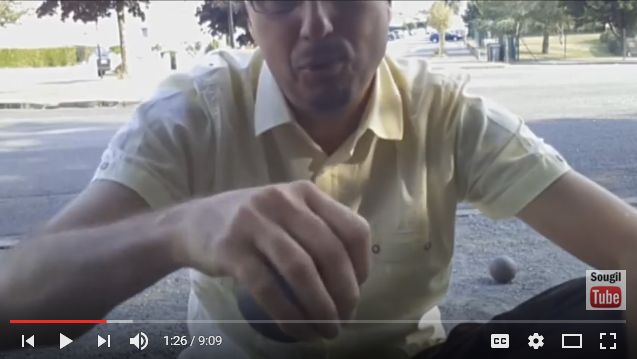 |
| Sougil85 Youtube channel. |
Also, you have to stoop to prevent from "over-lifting" the boule during release and landing it beyond the target boule.
What the Claw Method gives you is method, a repeated way to set up and execute your throw or shot. It gives confidence after repeated use. But make sure you lead with the knuckles to get a better feel of the boule in hand. This method may not work well with bigger boules.
The Claw method basically uses just the three middle fingers leaving the little finger and thumb out of the grip equation. If you do not "claw" your fingers, you are basically using the same "knock-on" grip. Three middle fingers pointing down when gripping the boule and "lift" releasing the boule.
Experiment and play with this style of grip. It might suit you. And do not forget to stoop. It's a way to get a carreau!
(Sougil85 has another video that teaches how to shoot short and long. Here it is. Note the swing back in both instances.)
B. SHOOTING TIPS FOR ADVANCED PLAYERS
Well, at this "advanced" stage, you know how to shoot somewhat, but want the following:
- Consistency;
- Carreau anytime;
- Pinpoint accuracy;
- Near shooting/Far shooting
- Different ways of hitting a boule.
Let's start from the bottom:
1. Different Ways of Hitting a Boule
- Watch the Marco Foyot training video in Dutch. It shows the various ways of hitting a boule.
Personally, I prefer to knock a boule away with my boule snot straying far. In this way, I "carreau" the point. (The actual definition of carreau is "to steal the point".)
 |
| Marco Foyot's excellent training video. |
The shooting part starts at 16:02
Note Foyot's ball holding, swing and follow-thru. It is deceptively simple.
2. Consistency
- With practice, comes consistency. I know I've mentioned many methods of shooting. Stick to one and practice until it becomes second nature.
Cross-hairs. I know, petanque players wonder if there is an "aiming" aid somewhere in the throw to enable one to aim and hit all the time. Does it exist in petanque? You look at consistent hitters such as Dylan Rocher (who once hit 98/100 boules in Bryant Park, New York) or Tyson Molinas and wonder if they have some secret trick. Or the players who take part in the "1000 Boules In One Hour" event and hit about 80% of the time. Do all of them have a secret?
Thus far, I find Christian Fazzino to be the most consistent. He hits a boule dead center all the time! Watch him here at 1:03:02 as he begins his excellent run.
Well, the short answer is no. I know having certain hand characteristics help. Better finger-pam dimensions, non-sweaty palms, etc. But whatever it is, helping the right boule size and weight matters more. Invest in a suitable set and practice. Develop a muscle memory for shooting.
Also, compete often so you won't get nervy during pressure situations.
3. Carreau Anytime
- Can one carreau anytime? I believe you can. Or effect a shot in such a way that a carreau chance is above 90%. How?
You must be able to attack a boule at the right angle, force and back spin. You can also adopt a "carreau throw", using the Elbow Method (see above section on this topic). Other ways is to follow how Fazzino and Rocher throw their balls. Look for those players who carreau often. You will realise that their boule impact is slightly different. Even if their shot do not end up as a carreau, their boule stops not too far away. This is important in a shooter's game. When your opponent's boules are all shot out of bounds, what remains is your own boule.
If you are like me, who can switch between playing competitively in badminton, tennis and squash in a day, then you'll be able to change your "shot throw" as and when required. Give yourself an advantage so to speak. But I bet your coach will not like it. "Stick to one way of playing," he'/she'll say. Yeah.
Another thing to consider when effecting a carreau is bending at the knees. This will bring your boule to a lower angle of attack. Better to kick the target boule out and away. Philippe Suchaud does this often, usually with an early release with faster follow-thru.
4. Pinpoint Accuracy
- As mentioned before, I find the trend of top players just hitting a boule away without considering how it might fly away as being rather careless. A flying boule can push a team boule away of even a jack. Care must be taken how a boule is hit. They should adopt a snooker mentality where every shot counts.
- Getting your line right is very important to accuracy. Certainly dipping your shoulder a little forward to allow your arm to swing freely in a straight line helps. This works for both low and high swingback players. Folks like Quintais and Lacroix both share similar shooting styles with short swingbacks. They appear to like flipping the ball at the end of the throw.
<on Christian Fazzino and Dylan Rocher throwing styles>
Both these players are very accurate, but their shooting styles are vastly different.
Fazzino: He is more a fingertip shooter. Notice he doesn't cup his boule fully in the palm. He holds it loosely to get feel and then swings it backwards and with a twist of the hips, launches it forward. Notice that he ends his swing with a "swipe" - right to left. This tells you a lot about his throw. He leads it with his knuckles, which helps direct the boule to its intended target and gives it line.
To carreau, Fazzino basically holds his boule the same way, but on his swingback, he curls his fingers up ever so slightly. In this way, his boule is directed more horizontally and hence landing more direct on the target boule giving a carreau. Notice that when Fazzino doesn't carreau, his shot is more of a knock-on shot. The impact is light and his boule doesn't fly away very far, allowing his boule to remain in play. Compare his impact to that of Sarrio.
Rocher: Now, this fella, who has shot 98/100 boules at Bryant Park in New York is somewhat ridiculous in his consistency. But it is no magic. He has found his sweet spot, and so can you. Some have called his swing rather exaggerated, but you can follow his example too.
Notice how Rocher starts his throw. He has a standard way of cupping his boule, hand pointing down with knuckles facing the target. This is essential as this grip allows him some spin to the boule on release. Try it. Rocher's secret is also his high swingback, which gives him effortless momentum on the down swing. Notice he doesn't do a quick swing back like young Molinas or even Damien Hureau. Another of his secret is his slow swingback. It comes down and then accelerates, allowing him flip his boule somewhat on the follow-through. He has his line and flips his boule at the right moment.
Rocher's slow swingback means he has a controlled forward swing. This allows him to bring his throw on line and control its forward lift and spin. This gives the boule a nice arc upon release.
Notice how his throwing arm ends up. It is in an awkward angle as if he has deliberately flipped the boule on its way out of the forward swing. It is precisely what he has done. You can even see his palm ending up vertical when his flip is extreme... all in an effort to land the boule with the right spin and forward moment on a target boule. And this is why he carreaus often.
The shooting styles of both Fazzino and Rocher are good to learn. Why? Because it they can call on a carreau effect anytime they want. It is in the nature of their throws. The impact and arc they achieve.
Their styles are vastly different from those of Molinas and Hureau, both very natural "roll-throw" shooters.
Why has Damien Hureau been losing in matches this 2017 summer? Roll-throw style shooters depend very much on perfect release, which is not something that is achievable under pressure. The nature of the throw is more feel and guess-work. Swingback, get the line, and release. The boule leaves the fingertips and you just hope for the best. (Check out the English Petanque Association training video under the Resources section. They also teach the Roll-Throw Method which is easy to learn.)
When roll-throw shooters miss, their boules tend to hit the ground and bounce away. Very rarely do they "knock-on" as compared to folks who add spin to their boules.
5. Practice With Smaller Targets
Practice with smaller targets - such as an indoor boule, or even metal door knobs - to gain that narrow aim and accuracy.
 |
| Stainless steel door knobs recycled as target boules. |
6. Near Shooting/Far Shooting
- I know some players have trouble shooting near after practicing at distances of 8-9 m. There is no way about it but to practice shooting at short distances as well.
- But during a competition, how do you overcome it? How not to over throw and miss? A shorter swing back? Earlier release? Cup the boule more? Stoop lower upon release?
- Well, it can be all of the above.
- It can also be applying a grip and flicking.
- Watch how Philippe Suchard and Henri Lacroix do it.
- For far shooting, carry on as usual. A bigger swing back will generate more force. You could also examine the role of the thumb in your grip. Its position on the index finger in some grip/boule holds can affect accuracy. It's like that windage control on a gun scope. Experiment with it to see how you can earn change your far shooting technique with it.
- The other way, as mentioned above, is to employ too a flick-grip. Why? Because a flick-grip released boule will also roll on the ground. If there is no direct hit, you could at least roll on or knock-on the target boule. I've tried it and found it more intuitive, especially with distances at 10m or beyond (because the jack has moved.)
Before: Throwing the Boule
Next: All Things Petanque Resource


